
Having hot coffee available at all times is a boost to your employees. Who can imagine an office which does not have a coffee machine these days? However, buying a coffee machine can be quite a task. There are many benefits of having coffee at workplace, since it is scientifically known to improve performance and productivity. Here is an infographic,
Author: Mariano Peluso
Café Culture in Coventry, UK

Coventry is a welcoming city, a changing city, and a city full of culture – it has submitted a bid to be the UK City of Culture 2021. When you think of café culture, Coventry probably isn’t the first city in the UK you think of, but like most cities across the UK, there is a thriving and growing café
Exploring Coffee and Cafe Culture in Portugal
Coffee culture is ingrained in the everyday life, culture and history of Portugal. The Portuguese were crucial actors in expanding the coffee industry into what it is today with Portuguese colonists introducing the coffee plant to Brazil. There isn’t space here to explore the rich history of Portuguese coffee culture, but I will write about this more at some point soon.
Drinking coffee in Portugal is an everyday part of life, with cafés found almost on every street, and espresso being the most common drink. Coffee is significantly cheaper to drink out of the home, than it is in the UK. An espresso wouldn’t usually cost you more than € 1 and in most cases is closer to € 0.50. If you ask for a coffee (um café) an espresso is what you’d be served, although there are regional variations for different coffees too. If you were in Porto and wanted an espresso you’d order um bica, while in Lisbon you’d order um cimbalino (named after the La Cimbali espresso machines). [Sign in to continue]
How to Green a Morning Routine
Coffee consumption has been rising to astronomically high levels all around the world. This comes as no surprise because a hot cup of coffee is what most people want to wake up to. But, do you ever wonder how many natural resources are required to make one cup of coffee? Coffee is one of the major reasons for creating environmental
Neighborhood and Coffee: Starbucks in Japan
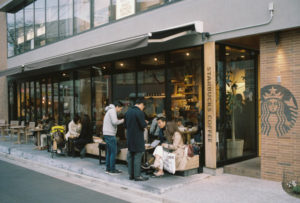
Starbucks, the global coffee chain company is starting to try and do things a little differently. Famous for introducing its stores with their similar style and operations across the globe, with increasing competition, the company has had to think about how it can move with the times and have a wider offering of store types. In some markets the company
Drilling in the Coffee Industry
CoffeeBI provides highly granular coffee market size estimations by geographical area. Four incremental depth levels are available to allow you to choose the right level and granularity of information for your analyses. Find out more about our market researches. Are you a CoffeeBI Community member? Find out the exclusive offers for you: click here.
The Language of Coffee: Latte Art
I found out recently thanks to a tweet from Bex, author of the coffee blog Double Skinny Macchiato, that ‘Latte Art’ is one of the new entries to the Oxford English Dictionary: “latte art: pictures of patterns made by skilfully pouring steamed milk onto the surface of a latte or similar coffee drink” It’s a sign that something which was
Brexit & The UK General Election
The UK was in shock momentarily when Theresa May, the British Conservative Prime Minister, announced a snap general election to take place on June 8th this year. For the last six months she had categorically ruled out another election, but she changed her mind in a dramatic fashion. It could turn out to be a political master stroke, so far
How New Technologies Impact Coffee Equipment? (Part 3)
Refractometers and the “Perfect Cup”
For the last episode of this small review of new techs related to coffee, I will try to consider the use of refractometers for the “Perfect Cup” preparation. Barista’s refractometers such as the VST and Atago are the most popular on the market. I will propose in a future post a scientific and statistical comparison between VST, Atago and the RE40D from Mettler-Toledo (professional laboratory refractometer).
Coffee Shop Culture in Australia
‘In Australia, coffee isn’t fuel for work – it’s a way of life’. Milkman (2016).
While coffee may be a global commodity, and coffee shop cultures have emerged across the world, each country tends to have its own flavour of coffee shop culture, each with their own histories, influenced by the movement of people and commodities around the globe. A particularly interesting case is Australia, described as the world’s ‘coffee capital’ by Perfect Daily Grind, which has a well-established coffee shop culture where the independent coffee shop dominates the landscape. It has been argued that Australian coffee culture has now achieved an important status representing “time out” warmth, intimacy and sophistication, with baristas representing cultural icons [Sign in to continue]